




Why Your Business is Stuck.
How profitability and scalability constraints in your business model keep you stuck and how to diagnose and remove them to finally grow.
If your business feels stuck – you are working hard but not breaking through – you may be dealing with hidden constraints in your business model.
In this episode, Henry Lopez explains why most small businesses don’t fail outright but instead get trapped in a perpetual startup stage. The root cause is often not effort or resources, but structural limitations in profitability or scalability or both.
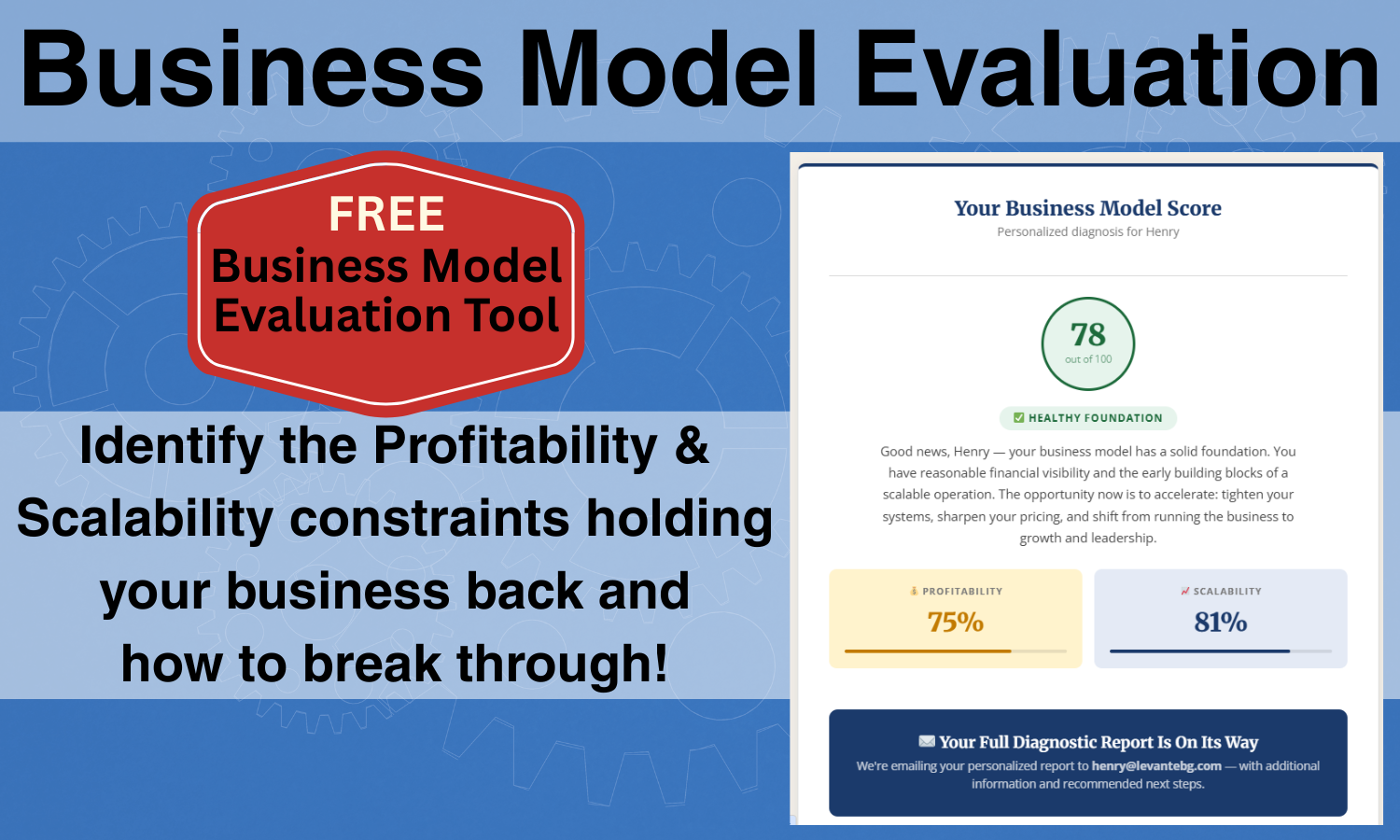
Henry breaks down the two pillars of a healthy business model and shows you how to diagnose what’s really holding your business back. He also introduces a simple tool to help you identify these constraints and begin addressing them: The Business Model Evaluation Tool
In this episode, you’ll learn:
- The difference between a business idea and a business model
- Why working harder won’t fix a broken business model
- The top reasons small businesses struggle with profitability
- The most common scalability constraints
- How to identify whether your business model can be fixed or you need to pivot
- How to begin removing the constraints keeping you stuck
Episode Host: Henry Lopez is a serial entrepreneur, small business coach, and the host of The How of Business podcast show – dedicated to helping you start, run, grow and exit your small business.
Resources:
FREE TOOL:
Other Podcast Episodes:
You can find other episodes of The How of Business podcast, the best podcast for small business, on our Archives page.
Transcript:
Henry Lopez 00:12
Welcome to the how of business podcast. This is Henry Lopez. Do you feel like your business is stuck? You’re working hard, maybe making some money sometimes, but never nearly enough. Do you feel like you’re never quite breaking through to the next stage? Well, what may be keeping you from growing your business to the next level are critical constraints in your business model. And on this episode, I’ll help you begin to identify what’s really holding you back. Is it profitability? Is it scalability, or is it both? And I’ll show you how to diagnose and start removing those constraints so your business can finally grow past the never ending startup stage. You can find all of the Howard business resources, including a new tool that I’ll talk about in this episode, the business model evaluation tool on the show notes page for this episode, and also learn more about my one on one and group coaching programs at the Howard business.com I also invite you to join the Howard business community on Patreon and subscribe wherever you might be listening so you don’t miss any new episodes. If you’ve been in business for a while, maybe a year or two years, and you still feel like you’re struggling just to stay afloat, then you may still be stuck in a perpetual startup stage because your business model is not healthy, and so many owners believe that I just need more time, or I need to make some more investment. I just need more money. If I can just get more customers, obviously, if I could just spend more on marketing, then I’ll break through. But the real issue is often not a lack of effort or even a lack of resources, although, of course, we’re all constrained by resources as small business owners, but the reality is that your business model is not working yet, or the reality might be that it’ll never work. But let’s be optimistic and assume that it’s a matter of constraints that currently exist in your business model, but you will never get past that perpetual startup stage if your foundational business model is not healthy, every business that is stuck is probably constrained at a high level, either by profitability, scalability or both. And so we’ll explore in this episode, and I’ll share with you a tool to help you diagnose this and also some tips on how to overcome, first of all, address, identify, and then hopefully overcome these constraints in your business model. Let’s step back for a moment, though, to clarify that there’s a difference between a business idea and what you do and how you do it, the business model that underlies how you make and deliver your product and service and how you make money doing so. So your business model will be limited, perhaps by certain constraints, and passion is not going to be enough to get you through those even effort is not going to be enough to get you through or pass those constraints. Doing what you love doesn’t guarantee profitability or a scalable business. And I mention this because often what I hear is the advice of just do what you love, do what you’re passionate about, and the money will follow. Boy, if it were only that easy you can love what you do and still build the business that does not work. The business model has to be sound, and we only know that really once we go to market and to market, our potential customers tell us whether it’s a sound business model or not. So if your business is stuck, it’s because of constraints in your business model, most likely and not a lack of passion, and probably not even a lack of effort. I suspect, in fact, that might be how you’re trying to overcome these constraints, is by working harder, longer hours, and that’s not going to fix the foundational problems in your business model. The reality, I have found, is that most small businesses don’t fail necessarily or outright. They get stuck for an extended time in a startup mode and then run out of money. Some of the common traps that I see are revenue without structure, which means revenue, you’re making some money, you’re selling stuff, but without the structure. That means you’re making sales, but there’s no system. There’s no margin clarity. You don’t know if you’re profitable on those sales. Another trap is busy without progress. You’re constantly working and completing an endless list of tasks, but those activities at the end of the day or at the end of the week are not moving the business forward in a meaningful or measurable way, and in effort without leverage your time and energy are not producing scalable results, meaning more work, more hours from you, does not lead to proportionately greater outcomes or growth. It just leads to burnout. Busy. Being busy can create an illusion of progress, and we often also hide behind it. We can all do this. I’ve spoken about this in other episodes that that chaos. Sometimes we are the source of that chaos, and it’s the excuse that we use why we can’t do the more important, the harder things that allow us to move the business forward. So all of these are symptoms of an underlying issue, underlying constraints in your business model. If your business cannot pay you well and produce a consistent profit, or cannot run without you or both, then it’s still behaving like a startup and your business model. Model is not healthy, or perhaps it might be completely broken. So let’s explore further these two pillars of a healthy business model. These two pillars determine if your business can grow, and they are again profitability and scalability, your growth, your ability to move beyond that perpetual startup stage, is likely constrained by one or both of those pillars or those constraints. If your model is not healthy across these two, you’re going to stay stuck, you’re going to burn out, or worse, you’re going to run out of cash, and your business will fail. This is Henry Lopez briefly pausing this episode to share exciting news about business bookkeeping. Yes, bookkeeping, it can be exciting, especially when it’s accurate and timely and you don’t have to do it. I’m excited to announce that I’ve launched the how of business bookkeeping, a technology driven essential bookkeeping service for small business owners like you, and I’m accepting a limited number of clients in our early access program. Let me ask you this, do you have accurate and timely financials to measure the performance of your business and help you make critical decisions? If you’re behind on your books, or tired of doing it yourself, or frustrated with your current bookkeeper, then I invite you to consider my new bookkeeping service, the how of business bookkeeping. The service includes your QuickBooks, online subscription monthly account and credit card reconciliations, accurate financial reports, a KPI dashboard and professional bookkeeping support, so you always know where your business stands, and you can make decisions with confidence. All of our bookkeeping work is performed by US based QuickBooks, certified bookkeepers, ensuring your books are handled accurately and professionally. And it’s all brought to you by my company, the how a business a name you can trust to help you run and grow your small business. And right now, I’m waiving the $99 onboarding fee for new clients. So to learn more or to schedule a free consultation, just visit the how a business comm look for the bookkeeping service link on the home page or on the menu. Take that first step today, and finally, get the timely and accurate bookkeeping you need to help you grow your small business. Visit the how a business comm to learn more.
Henry Lopez 07:13
Let’s explore profitability a little deeper. The top five reasons why perhaps you’re not profitable, and if you’re not profitable, keep in mind that profitability is your primary constraint then, and the one that you have to fix. That’s the key idea of a for profit business, right? So number one, is under pricing. This is critical. Are you under pricing your product or service? Number two, your cost structure is too high, and this might be one that leads you to realize that the business model won’t work if that cost structure is too high, perhaps you didn’t understand it clearly and startup or maybe those costs have shifted wildly on you because of the economy or supply chain or whatever the case might be. But those high cost structures, your cost of goods sold is too high for you to make a profit on delivering that product or service. That’s number two. Number three, there’s not enough volume, not enough people, at least where you’re offering or how you’re reaching them, that want enough of the product or service to make it scalable enough and then thin margins. And of course, these things are interrelated. But if you don’t know your margins, by the way, by product line, even down to individual products or services, then I would venture you don’t know your business well enough. And five, you’re not compensating yourself. You’re not paying yourself sufficiently. So those are five things to look for, five reasons why your business is not profitable consistently and sufficiently. In the book, scaling up, Verne Harnish talks about this. I think there’s a great book on this topic, and he says that growth sucks cash. If your business model currently isn’t profitable, and you continue to grow it with that same constraint, then that just kills you, because it continues to drain you of cash. It creates that cash crunch situation because that business model is broken, particularly on the profitability side. And the thing you have to realize is some business models only work at scale, especially if we’ve built a business model that depends on volume, so that those tighter margins, let’s say, actually can work. But getting there requires a lot of effort, a lot of energy, and a lot of resources that we may not have realistically. And so we can never get to that scale where the business model can be profitable. You simply don’t have those resources. And so if that’s what your business model is dependent on, is scale, let’s say, because we’re going to be the cost leader, like a Walmart can or an Amazon can, but we’re nowhere near that skill, nor likely do we have the resources to be able to get there, we might aspire to, but we can’t get there, and that will kill your business before you ever get there. Let’s talk about now scalability. Top five reasons why perhaps your business is not scalable, and if your business is not scalable, then that, of course, is the key constraint that you need to address. Owner dependency is number one. If everything runs through you, then nothing scales. No systems. So there’s no repeatability in place. There’s one or two, or maybe it’s just you, one or two people, where everything is in their heads. Otherwise nothing operates. It’s too customized. What you’re delivering, the product or the service is so customized, so highly engineered, that that complexity keeps you from being able to scale. There’s no team, and so there’s no leverage. If what you’re looking to do is to be a solopreneur, that’s fine. This doesn’t apply. But if you’re looking to build a business that scales beyond you, then at some point you have to be able to make the investment in a team. And a team can be, of course, internal people that you hire w2 employees. Could be contractors. Could be freelancers, could be partners, could be outsourced providers. And number five is the fact, again, that growth creates chaos. If growth makes life harder in your environment, then you’re not really scaling. You’re just growing, but not in a methodical way, and not in a way that’s sustainable. An example of that might be, let’s say you have a services business, and you are reaching for business, and so you’ll take anything that comes your way, even if it’s you know, more than that 50 mile radius that you set for yourself. And now you’ve spread yourself so thin. Yes, you’ve got revenue coming in, but it’s costing you, and since you’re the only one that can deliver it, perhaps, or one or two other people, you can’t scale. You’re running around like crazy trying to chase that revenue. It’s not profitable revenue, and you can’t scale it, and all it takes is more hours, and you’ve already given your business all the hours that you have. So again, referring here to the book scaling up by Vern Harnish. He talks about this as well, and he says that scaling requires discipline across people, strategy, execution and cash. And if those are not aligned, then growth just reinforces the constraint. It doesn’t fix the constraint. And so it takes a balancing act of those things to be an alignment for you to be able to scale and grow, so that you can be both profitable and be able to continue to grow past that perpetual startup stage scaling often requires an investment in systems and a team, and if you don’t have those resources, then that in itself becomes the constraint, at least on the scalability pillar. Growth often requires subtraction before addition, meaning you’ve got to remove complexity and make things more streamlined and repeatable so that you can scale, so that others can perform some of the tasks, if not all of them. So the key is to diagnose what are the real constraints that are keeping your business from growing to the next level? And most businesses are constrained somewhere. So either it’s profitable but not scalable, or scalable but not profitable, or neither they you can’t profit consistently and you can’t scale your business. So a couple of questions again to ask yourself, do you know your true margins, by product, by service line? What are your profit, gross profit we’re talking about now. But if you don’t have an idea of what your margins are, then likely that’s one of the critical things, one of the critical areas of constraint that’s keeping you from being consistently profitable. Can you raise your prices without fear of losing most of your clients? Are you leading or differentiating by being the lowest cost provider? And can you compete without discounting? If any of those describe your situation, then you’ve got a huge challenge and your business model is broken. And then also, is there demand? Is the demand for your product or service predictable, or is it random? You want to identify the constraint start at the high level. Is it profitability? Is it scalability? Is it both? Then diagnose the root causes and then obviously begin to fix those root causes that are leading to these constraints. However, if your business model requires resources, you don’t have money time people, then you may need to redesign the business model. You need to adjust a business model. I often see this when people are trying to launch or build a business that is at a scale that’s ahead of its time. You’re not ready for that scale. You simply cannot afford the resources to really operate at that scale. You’ve got to get past the earlier stages first and then get to that eventual vision or size of the business that you would like for yourself. You have to take it a step at a time. But what if your business model can’t be fixed? And that’s a harsh and hard reality that probably nobody wants to tell you, and we certainly don’t like to tell ourselves. I’ve faced this several times in my business ownership career, and it’s the hardest thing to do, so hardest thing to face. I always say there’s two hardest decisions a business owner would ever have to make. One is to sell a highly profitable business, even though you’re going to make a handsome profit on it, and number two is even harder, which is to realize and admit to yourself that the business model is broken and it can’t be fixed. And in some cases, the constraints on your business model are simply not fixable if the business only works at scale, for example, as I’ve mentioned, and you can’t realistically reach that scale or it requires resources that you simply don’t have. Have but won’t be able to get then the model itself is broken and you may not be able to fix it at that point, the right move is not to keep pushing harder or to put in more hours or to keep at it or to give it another year. Necessarily. It’s to pivot to simplify or to redesign entirely the business model. Sometimes the underlying economics simply don’t work. There’s not enough margin, not enough demand or enough differentiation for the business to ever become sustainably profitable. Forget about scalability. Now, those are harsh words. I get it, but often I see people continue to put money into a business, or continue to put their effort behind a business that is simply never going to succeed. I get it. It’s easy enough for me to say that to you, you’re in it. Maybe you’re in a lease, or maybe you’ve gotten that SBA loan, and you’re on the hook for all of that, and so you got to keep trying. I understand, but just be realistic and honest with yourself that at some point, when it’s possible and when it makes sense, what might be the best answer is to completely pivot, or to shut down the business and move on to something else. Sometimes the breakthrough is not fixing the business, it’s completely changing it. Let’s come back from that negativity and talk about, if you do have a business that has these constraints, first of all, how do we identify them? So I have a free new business model evaluation tool that you can access at the show notes page for this episode at the Howard business comm. And what this tool will do is help you diagnose at a high level, is it about profitability, scalability or both? You’ll answer 16 questions about your business, and then you’re going to get an instant score that will help you identify which one of those pillars, profitability, scalability, or both, and it’ll give you an overall score. What’s great about this? Obviously, it’s high level, but the questions are thought through to identify and help you begin to focus, or identify where to focus that might be the area of most concern. Then you’ll do that further root cause analysis to identify, as I’ve just shared here in this episode, what are some of those specific lower level root cause constraints that are leading to these higher level constraints in your business? So go to the Howard business.com go to the show notes page for this episode, and take about five minutes to fill out this evaluation tool and get your score to help you begin to navigate what is that needs to be fixed about your business model. So for your business to begin to shift and grow from a startup, perpetual startup stage to growth mode, you don’t do so by working harder. You grow by removing, addressing and removing those constraints in your business model, profitability constraints that have to do with the finances of the business, scalability constraints that have to do with the operations of the business. If your business is not consistently or sufficiently profitable, then it will continue to drain cash until it kills your business. If it’s not scalable, your growth, whatever growth you do achieve, just creates further chaos. Either way, these constraints keep you stuck in that perpetual startup mode. The shift from startup to growth is not just about hustle, it’s discipline atop a healthy business model systems. Beat willpower. Of course, you need that work ethic, but more anything else, you need the discipline and the honesty to evaluate your business, perhaps get some help in doing so, and then fix those root cause issues that are leading to these constraints. Growth is not just about more sales, although, of course, that’s key to any business. Growth is about removing those constraints, those barriers. The goal, again, is not just to work harder. It’s to build a business that works, that consistently delivers the profits that you need and deserve for your effort and for your investment, and that can scale beyond you, so that you can remove yourself from the day to day of the business and start to realize the rewards of business ownership. There’s a warren buffett quote that I think is appropriate here. Quote, the most important thing to do if you find yourself in a hole is to stop digging. End quote. There’s also a book that I read recently that I did an episode about by Seth Godin called the dip that I think also applies here. Are you in a cul de sac and you need to pivot? Or is it a matter of continuing to persevere, but if you’ll do the analysis of understanding and identifying the constraints and then determining can these things be fixed, or is my business model need to be pivoted or adjusted? Then that’s the key to making progress. This is Henry Lopez, and thanks for joining me on this episode of The how a business. I wish you the best as you start and grow your successful and profitable small business. I release new episodes every Monday morning, and you can find the show anywhere you listen to podcasts, including the how of business, YouTube channel and at my website, the how of business.com thanks for listening.