


The Trust Factor: How to Build Trust Fast.
Trust runs every small business relationship. One simple formula, the trust equation, shows small business owners how to earn it faster without faking it.
The trust equation gives small business owners a simple way to earn trust faster with customers, employees, vendors, and partners: lower your self-orientation and put the focus on the other person’s success.
People don’t buy from, partner with, or make deals with people they don’t trust. That’s often true even when you have the better product or the better price.
Most small businesses don’t have a big brand name doing the work for them. The owner or a key employee is the face of the business, and word of mouth and referrals, the lifeblood of new opportunities, depend on trust. The challenge is that trust takes time to build. You often get only one sales call, one first meeting, or one negotiation to start.
In this episode of The How of Business, Henry Lopez explains the trust equation from The Trusted Advisor by David Maister, Charles Green, and Robert Galford. Henry taught this book throughout his sales training and enablement career. He also covers the one variable in the equation that can speed up trust more than any other.
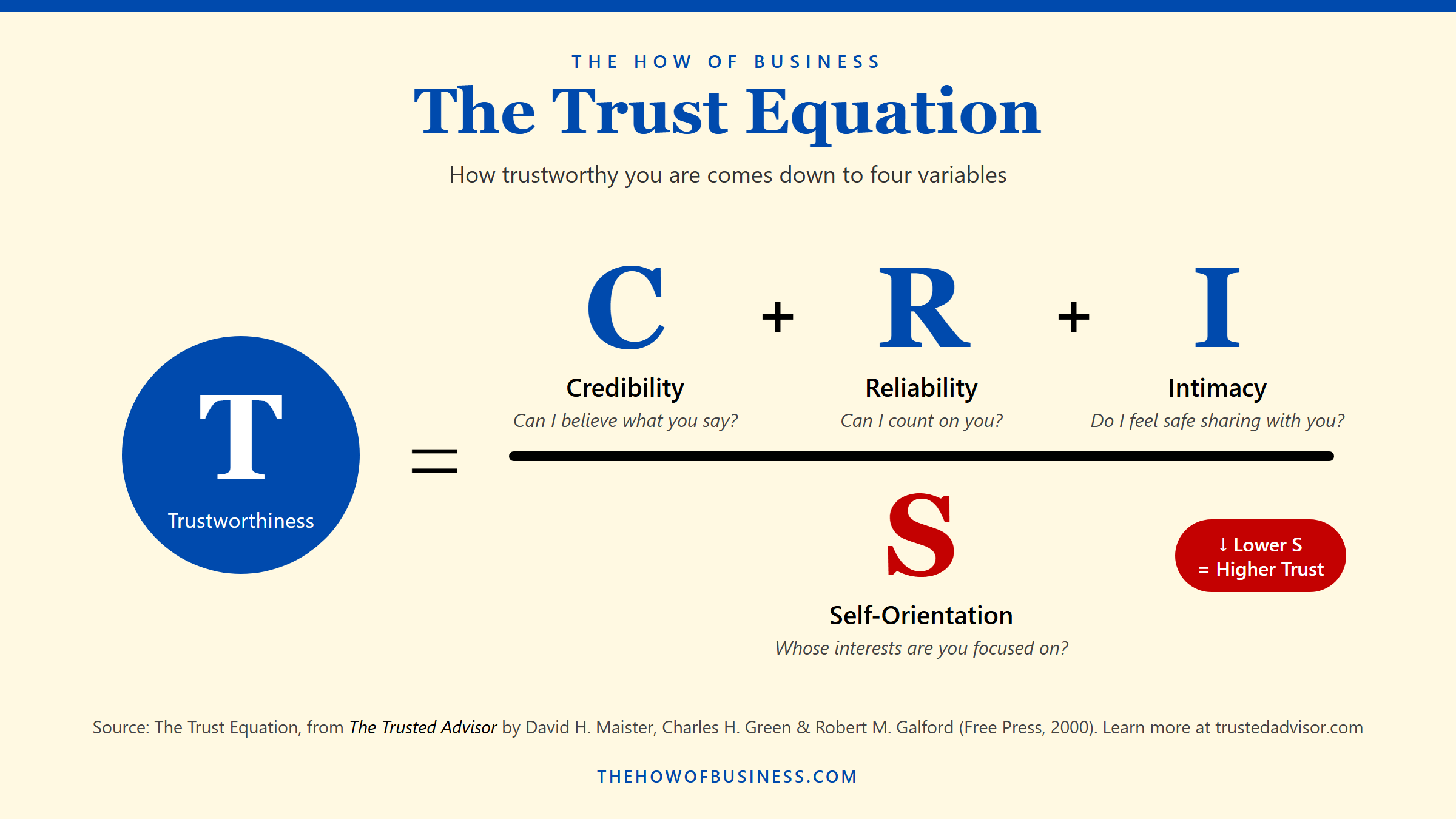
The formula is simple: Trustworthiness equals credibility plus reliability plus intimacy, divided by self-orientation.
Credibility asks, “Can I believe what you say?” Reliability asks, “Can I count on you to do what you say?” Intimacy asks, “Do I feel safe sharing my real problem, budget, and concerns with you?” Self-orientation asks, “Whose interests are you really focused on?”
Henry shows the math with a 1-to-10 scale. Score a 7 on credibility, reliability, and intimacy, and a 7 on self-orientation, and your trustworthiness is 3. Raise each of the top three by a full point and it only climbs to 3.4. Leave the top alone and cut self-orientation to 3, and trustworthiness jumps to 7.
That is the power of the denominator which is your self-orientation in any interaction or situation.
Credibility and reliability take time to prove. Self-orientation shows up in the very first conversation, and people sense it right away.
The equation isn’t just a sales technique. It applies to home services customers, new hires, vendors, referral partners, and negotiations.
The Trust Factor – 4 Questions:
Before your next important conversation (a sales call, a new hire, a vendor, a partner, a negotiation), ask yourself:
- Credibility: Am I prepared, and honest about what I don’t know?
- Reliability: What small commitment can I make and keep right away?
- Intimacy: Am I creating a space where they can tell me the real story?
- Self-Orientation: Am I focused on their outcome, or on mine?
The Trust Factor – Key Takeaways:
- Trust is your competitive advantage.
Without a big brand behind you, trust drives faster decisions, fewer objections, more referrals, more repeat business, and easier negotiations. - Trustworthiness is a formula you can work on.
Credibility, reliability, and intimacy go on top, and self-orientation goes on the bottom. Raise the top three and lower the bottom one. - Self-orientation is the fastest lever.
Small gains in credibility, reliability, and intimacy barely move the score and take time. Cutting self-orientation can double your trustworthiness right away. - People sense self-orientation immediately.
When someone feels you care more about your interests than theirs, trust drops. When they feel you’re focused on solving their problem, it can rise quickly. - Listen more than you talk.
If you did most of the talking on a sales call, you probably weren’t asking enough probing questions. Focus on their problem before your solution. - Be the guide, not the hero.
Put the customer at the center of the story. Being willing to refer someone elsewhere builds trust faster than chasing a sale that doesn’t fit.
Episode Host: Henry Lopez is a serial entrepreneur, small business coach, and the host of The How of Business podcast show – dedicated to helping you start, run, grow and exit your small business.
Resources:
Books:
- The Trusted Advisor by David H. Maister, Robert Galford, Charles Green
- Building a StoryBrand 2.0: Clarify Your Message So Customers Will Listen by Donald Miller
Related Podcast Episodes:
You can find other episodes of The How of Business podcast, the best podcast for small business, on our Archives page.
Transcript:
The following is a full transcript of this episode. This transcript was produced by an automated system and may contain some typos.
Welcome to The How of Business podcast. This is Henry Lopez, and on this short episode, I’m going to share my thoughts and experiences related to why trust matters so much in business relationships, and how one variable or technique can have a significant positive impact on how quickly people trust you.
You can find all of The How of Business resources, including the show notes page for this episode, and learn more about my one-on-one and group coaching programs at thehowofbusiness.com. I also invite you to join The How of Business community on Patreon, and please subscribe wherever you might be listening so you don’t miss any new episodes.
Every business relationship you have runs on trust, whether it’s with your customers or clients, your partners, vendors, employees, and certainly anyone you’re negotiating with. The reality is that people don’t buy from, or partner with, or make deals with people they don’t trust. Often, even if you have the better product or the better price.
And as small business owners, you’re often the face of your business. Your clients and customers aren’t trusting a brand. They’re often trusting you or one of your key employees.
During my sales training and enablement career, one of the books that I read and taught from, and kept coming back to, is The Trusted Advisor by Maister, Green, and Galford. It’s where I learned a simple formula, or technique, that really changed how I think about trust and how I taught others in the sales arena about trust. And it’s the trust equation in particular, which comes from this book, that I’m going to share with you today.
Trust isn’t a technique you pull on someone; it’s something you earn. But there’s a way to earn it faster, and that’s the key thing, because trust takes time to build. And so, on this episode, I’m going to focus on why trust matters so much, how the trust equation works, the one variable in that equation that can have the biggest impact on how quickly people trust you, or at least on accelerating that trust development, and how to apply it in every relationship you’re building in your small business, including in sales.
Trust is the foundation. Trust is critical to any effective relationship. With trust, you get faster decisions, fewer objections, more referrals, more repeat business, and easier negotiations. Without it, it seems like every conversation is harder, every price gets questioned, every contract gets scrutinized.
In a small business especially, you don’t typically have a big brand name doing the work for you. Maybe you have a franchise, and so you have that advantage. But typically, at a local level, for our small businesses, trust can be your competitive advantage. Word of mouth and referrals run on trust, and very often for small businesses, that’s the lifeblood of incoming opportunities.
But the challenge is that trust takes time. It grows through experiences that your customers and your clients and other constituents have with you, repeated over time. There’s really not a great shortcut to gaining ultimate trust. But often you don’t have a lot of time, right? It’s a first sales call, or a first meeting with a potential partner, or a single negotiation. So the question is, how do you speed it up? How do you speed it up without faking it, without coming across as insincere and having it backfire on you and actually dilute trust?
As I mentioned, in the book The Trusted Advisor by David Maister, Charles Green, and Robert Galford, they put forth the trust equation, and I’ll have a visual of this on the show notes page for this episode at thehowofbusiness.com. But I’m going to walk you through it here, because it’s so critical to understand this simple formula. And again, don’t get hung up on trying to write this down. If you’re not where you can write, just listen, and then go to the show notes page at thehowofbusiness.com to learn it further and to share it with others on your team.
We have trustworthiness that we’re trying to improve or increase or develop, and the formula is credibility plus reliability plus intimacy, divided by self-orientation. So again: credibility, reliability, and intimacy. If I’m picturing this as a formula, those are across the top, and then below it, we’re dividing by self-orientation.
So the three things across the top of the formula are the things you want to increase, and the self-orientation that we’re dividing by is the one thing you want to decrease. And these things help us improve our overall trustworthiness with a customer, with a client, with an individual, whatever the case might be.
So let me break down those across the top of the formula. Let’s start with credibility. And as we’re going through these, think of it as scoring yourself on a scale of one to 10 in each of these categories.
Credibility is about: Can I believe what you say? The customer is asking, “Can I believe what you are telling me?” And that typically comes across in your expertise, your knowledge about your product or your service or the industry, and being honest about what you know and what you don’t know. In small businesses, what that might look like is knowing your product or service inside and out, but also being able to say, “I don’t know, let me find out,” when you get asked about something you don’t know about, instead of trying to spin it or trying to fake that you know. Those are key to building credibility.
The next factor is reliability. Can I count on you to do what you say? And this is such a big one for small businesses. It’s following through on your commitments, and it’s all about consistency over time. But of course, for an individual customer, it could be just one event: showing up on time, showing up within the window of time that you promised. It could be calling back when you said you would, or delivering by the date you promised. And of course, showing up on time is critical if you are providing a service or delivering something. So that’s reliability.
So we’ve talked about credibility and reliability. The last element at the top of the formula is intimacy. Do I feel safe sharing with you? Now, this is not in a personal, weird way. It’s about whether someone is comfortable telling you their real problem, their real budget, their real concerns or objections. Are they able to open up with you? Well, that’s because, to some level, you’re seen as someone to be trusted.
So those are the three elements across the top of the formula: credibility, reliability, and intimacy. And as you’re thinking through this, again, score yourself on a scale of one to 10.
And now we’re going to divide that by self-orientation. Self-orientation is about the question: Whose interests are you focused on? Who are you focused on during the conversation, or the sales pitch, or it could even be the text on your website? How much are you focused on yourself, your sale, your commission, your image, being right, versus the other person and their success, your client’s perspective, and helping them achieve what they’re trying to achieve or solve the problem that they have?
The key point is this: it’s the only variable in the denominator, and that’s what makes it so powerful. I’m going to give you more details on this key component of the formula. But again, as you have it in your head, or if you’re looking at the image, or you’re somewhere you’re able to write it down: trustworthiness equals credibility, reliability, and intimacy, divided by self-orientation.
This is Henry Lopez briefly pausing this episode to invite you to schedule a free coaching consultation with me. I welcome the opportunity to chat with you about your business plans and offer the guidance and accountability that we all need to achieve success. As an experienced small business owner myself, I understand the challenges you’re experiencing, and often it’s about helping you ask the right questions to help you make progress toward achieving your goals, whether it’s getting started with your first business or growing, and maybe exiting, your existing small business. I can help you get there. To find out more about my business coaching services and to schedule your free coaching consultation, please visit thehowofbusiness.com. Take that next step today toward finally realizing your business ownership dreams. I look forward to speaking with you soon.
Let’s talk more about self-orientation, because this is the game changer. Let’s say you scored yourself on this trustworthiness formula. If we use, again, a scale of one to 10, let’s use as an example that I scored myself a seven on credibility, a seven on reliability, and a seven on intimacy. That adds up to 21. Even I can do that math. Now divide that by self-orientation.
And let’s say that in my pitch (we’re going to assume this was a sales pitch of some sort), I’m going to rate myself a seven. I didn’t go overboard talking only about myself and my features, but it was what I led with. It was about highlighting our experience: “Look at our Google reviews. We did this for your neighbor. Here are our features. We’ve been around for 100 years.” All of those things. That’s what I led with, and I did most of the talking in the conversation.
So I scored myself a seven. The 21, the total of credibility, reliability, and intimacy, divided by seven equals three. So if I look at it, again, on a scale of one to 10, my trustworthiness score is a three. Not great.
Now, if you work really hard to improve credibility, reliability, and intimacy, let’s say you increase each by a full point. So instead of a seven across those three, you score yourself an eight, and self-orientation remains the same at seven. Now that gives you a whopping 3.4. The point here is that it doesn’t move the needle much, relatively speaking, if you just slightly increase credibility, reliability, and intimacy. Those things are important. They’re critical to the formula. You can’t have a zero there. But there are two takeaways: a small improvement doesn’t have a great impact on overall trustworthiness if we’re applying this formula, and those things take time. Those are the two things I want you to think about.
But what if you were to leave those scores alone? Leave it as a seven in credibility, reliability, and intimacy, and instead, you improve your self-orientation. Let’s say to a three. Now 21 divided by three is seven. That’s how impactful it can be if you just focus on reducing self-orientation.
Let me say that again. Reducing self-orientation, in any situation where you are trying to communicate with others, sell to others, negotiate with others, or partner with others, has more impact than anything else on improving your trustworthiness in a short period of time. And that’s, again, because credibility and reliability take time to prove. But self-orientation shows up in the very first conversation. People sense it immediately, and they respond to it immediately. The moment someone senses you care more about your interests than theirs, trust is impacted. When they sense you are genuinely focused on them and on helping them solve their problems or achieve their desires, trust can rise pretty quickly.
There’s a story in the book I referred to, The Trusted Advisor, that Maister, one of the authors, shares. He was looking for an attorney at the time to handle his relative’s will, and firm after firm that he spoke with pitched him on when they were founded, how many offices they had, what they charged, their expertise, their credentials. But one of the attorneys he spoke to instead asked Maister if he already knew the process: What happens in putting together a will? What are the key components? And then he offered to send him a free outline of the steps. He took an educational approach, a consultative approach. He focused on Maister instead of his credentials. Not that those don’t matter, but that comes later. And that’s the one who earned his trust. He displayed low self-orientation in just one phone call.
Now, what does high self-orientation look like? Talking about yourself, your company, and your credentials too early and too much. Again, I’m not saying those things aren’t important, but typically people can go get that information themselves. They’ll go to your website to vet you, or you’ll share it with them later. What we’re talking about here is not necessarily leading with that.
Another is relating their story back to your own experience: “Oh, I had that happen to me,” or “I’ve been through that same situation.” That never works, in any conversation, to make the other person feel heard or better. It makes it about you now, not them.
Finishing their sentences, jumping to the solution, or assuming you know the objection they’re about to bring up before they’ve even finished explaining the real problem they have, before you’ve even dug in with “why” questions to understand what the root cause of their challenge might really be.
Another common one is needing to be right or to appear smart, and I get where that comes from. We’re nervous, or we want to make sure we don’t get seen as imposters, and so we can tend to make up for that by bringing proof to the table right off the bat that we know what we’re talking about. And then perhaps, if we’re talking about sales, pushing too hard or too soon for the close. I’m not saying you don’t trial close, depending on the product or service you’re offering; you just have to be careful about how it’s going to be received by the potential client or customer. Or if it’s a negotiation, pushing your agenda too hard.
So those are some examples of where you’re going to exhibit high self-orientation, and that’s going to negatively impact your overall trustworthiness, especially in those initial meetings.
So how do you lower self-orientation, so that in a relatively short period of time you can raise trustworthiness in any relationship? Some of this might start to be obvious, but listen more than you talk. One of the things I focus on when I’m helping people with sales enablement, helping them sell better, and I even apply it to myself, especially now that we have the technology to help with this, is recording the conversation and then having technology or AI measure the percentage of time you talked as the salesperson versus the prospective customer. If you did the majority of the talking, typically, that’s a bad sign. You weren’t listening. You weren’t asking probing questions.
So ask questions, and then ask follow-up questions. Focus on their problem before your solution. Earn the right to talk about what you offer.
Be the guide, not the hero. The customer is the hero in this journey, and that puts the focus on them and lowers self-orientation. If you’ve read the book Building a StoryBrand by Donald Miller, I suspect some of this resonates: the whole hero’s journey.
Be willing to walk away and refer them somewhere else. You might say, “Joe, honestly, I’m not the best fit for this, but here’s who is.” Nothing builds trust faster than not going for a sale when it’s not a fit, and being a resource to help someone solve their problem.
In negotiations in particular, understand what the other party needs. Look for the outcome that works for both sides. It’s called win-win negotiation, and certainly in our culture, that’s what most people feel comfortable with, not just a win for you.
But the thing is, if you don’t actually lower self-orientation, and you only pretend to care, people see right through that. You lower it by actually shifting your focus to their success, to their desired outcome or transformation.
Let’s talk a little bit more about applying this to different types of relationships, improving trustworthiness and lowering self-orientation. This isn’t just a sales technique. As a small business owner, you’re building relationships in every direction, every day. Same equation: lowering self-orientation will increase your overall trustworthiness in a shorter period of time.
Let’s focus again on customers, whether new or existing. When something goes wrong with an existing customer, own it fast. Don’t necessarily defend yourself, unless it’s appropriate. How you handle a mistake, an issue, or a miscommunication can build more trust than never making a mistake. Think about that. In a lot of cases, it really can be an opportunity to turn it into a positive.
Going back to home services in particular, trust starts before you even walk into the person’s home or place of business. You’re a stranger asking someone to let you into their home, and they judge you within seconds. Your vehicle: what does it look like? How you present yourself, whether you put on shoe covers or took your shoes off, how prepared you are. Do you have what you need to get the job done?
One tip I see very successful home services companies use is to send a short video ahead of time, maybe the day before, on what to expect. That way, when you show up, the customer is prepared, it alleviates a lot of the stress or unknowns for them, and that can help with trust.
It’s also about the other things across the top: your commitments, showing up when you say you’re going to, or letting me know that you’re not going to show up, or updating me. All of those things impact credibility and reliability at the top of the formula.
I had the opportunity to interview Dean Curtis recently on episode 619, and there’s a good quote from my conversation with him on this: “No one cares what you can sell or what you can install if they don’t trust you.”
How does this apply to employee or new hire relationships? Reliability from the formula comes in here: keeping the promises you made in the interview. The employee is really still thinking about, considering, and determining whether they made the right choice in joining your business. So that onboarding experience is critical, because they want to make sure that what they thought this was going to be is actually how it turns out. Intimacy also comes into play here: making it safe for them to bring you bad news, for example, or admit a mistake.
As it relates to the vendors and suppliers in your business, paying on time is a key one, as is telling them early when there’s going to be a problem. I think that is critical to those relationships. Take an interest in their business too, and in how you fit into it. That’s really where we turn a vendor into a partner: a vendor who trusts you and will take care of you when you need it, when supply is tight, or when a situation arises that you need help with.
As it relates to business partners, referral partners, or other alliances, early on, be clear about what’s in it for them, not just for you. If you send a referral before you ask for one, well, you’ve built trust. They can rely on you. They understand that it’s not just about you. Keep your small commitments early, because that builds reliability quickly.
When it comes to negotiations, any kind of negotiation, low self-orientation doesn’t mean giving everything away. It doesn’t mean you’re going to give up your leverage. You can still advocate, of course, for your interests and what you’re trying to get out of that negotiation. But it does mean, to some extent, being transparent, understanding their position, and looking for the outcome that works for both sides. Otherwise, it’s not really a negotiation.
It’s the same four questions in every relationship that people are asking as far as trust goes: Can I believe you? Can I count on you? Do I feel safe with you? Are you focused on me, or on yourself? So think about those four questions, and if you answer them in the positive, that will reduce your self-orientation and exponentially raise your trustworthiness. True trust takes a long time to build, but only a moment to lose.
So how do you get started? Here’s what I would challenge you with. Before your next important conversation, whether it’s a sales call, a new hire you’re bringing on board, a vendor you’re working with, a partner, or something you’re negotiating, ask yourself these four questions. I’ll have them on the show notes page for this episode at thehowofbusiness.com.
As it relates to credibility, the question is: Am I prepared, and honest about what I don’t know?
As it relates to reliability: What small commitment can I make and keep right away? I said I’m going to call you at three; I call you at three. I said I’m going to follow up by sending you a case study through email by tomorrow; I do so. Those are just simple examples, easy to accomplish, but sometimes we overlook those things because we’re busy or we’ve got other things going on. But our customer, or the person we’re meeting with, or a prospective client, doesn’t care about all of that. They just care about the challenge or the problem they have that I’m saying I can help them solve. So that’s credibility and reliability.
Number three is intimacy. These are the three things across the top of the formula. Intimacy is about: Am I creating a space where they can tell me the real story, the real root cause, the real challenges, the real reasons they think it may or may not work?
And then the most important factor, the denominator: self-orientation. That’s the key component. We can reduce our self-orientation, and that can have a very immediate impact on overall trustworthiness. Even though it does take time to build trust, this is how we can accelerate it. And the question here is: Am I focused on their outcome, or just my outcome?
If you only work on one of those four, make it number four, self-orientation. Reducing it has the biggest impact, and it’s the fastest to results.
So I want to challenge you. I’ve put an image of the trust equation on the show notes page for this episode at thehowofbusiness.com, along with a link to the book I keep referring to, The Trusted Advisor. Use it, review it, print it out, share it with your team, talk about it, and then commit it to memory. But I’m not asking you to memorize the whole formula, even though it’s simple. I’m asking you to remember to reduce self-orientation to increase trustworthiness in a short period of time.
Trust is the foundation of every effective business relationship, and personal relationship for that matter, and particularly as it applies to sales. Trust takes time, but the fastest way to earn it is to make it about them, not about you.
This is Henry Lopez, and thanks for joining me on this episode of The How of Business. If you have any comments or thoughts on this, I encourage you to comment either on my website or wherever you might be listening to this episode. I wish you the best as you start and grow your successful and profitable small business. I release new episodes every Monday morning, and you can find the show anywhere you listen to podcasts, including The How of Business YouTube channel and my website, thehowofbusiness.com. Thanks for listening.